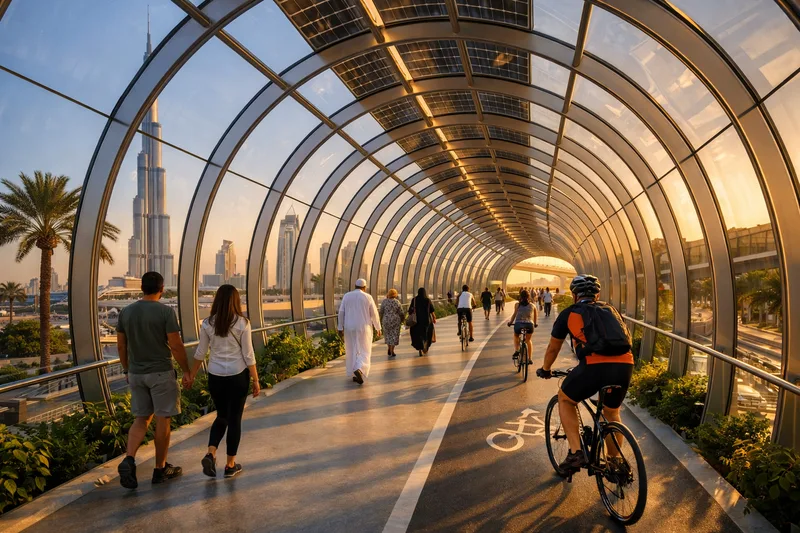
Dubai has never struggled with ambition. From the tallest building in the world to man-made islands visible from space, the city has consistently bet on bold infrastructure to shape its identity. But a recently proposed project — The Loop — might be the most meaningful yet. Not because of its scale, though a 93-kilometer climate-controlled corridor for walking and cycling is certainly massive, but because of what it signals: a shift from spectacle to livability.
What Is The Loop?
The Loop is a proposed enclosed, climate-controlled pathway stretching across Dubai, connecting communities, transit hubs, and commercial districts through a continuous walking and cycling corridor. Designed to be usable year-round — even during summer months when outdoor temperatures regularly exceed 45°C — the project reimagines how people could move through the city without relying on cars.
The concept was introduced by URB, a Dubai-based firm focused on sustainable urban development. At 93 kilometers in length, The Loop would effectively create a parallel mobility network beneath or alongside existing infrastructure, offering residents and visitors an alternative to road-based transportation.
Why It Matters for Dubai
Dubai is one of the most car-dependent cities in the world. The urban layout, extreme heat, and lack of pedestrian-friendly corridors make walking or cycling impractical for most of the year. This has consequences — not only for traffic congestion and emissions, but for public health, quality of life, and the long-term attractiveness of the city for residents and talent.
The Loop addresses all of these issues at once. A climate-controlled corridor would make non-motorized transit viable regardless of the season. It would reduce short-distance car trips, support fitness and outdoor activity, and create new connective tissue between neighborhoods that currently feel isolated from one another.
Impact on Health and Wellbeing
One of the most significant potential outcomes of The Loop is its impact on public health. In a city where much of daily life happens indoors or inside vehicles, a continuous, comfortable walking and cycling path could change daily habits at a population level. Regular physical activity reduces the risk of cardiovascular disease, diabetes, and mental health conditions — all of which are rising concerns in the Gulf region.
The corridor could also serve as a venue for community activity: running clubs, cycling groups, family walks, and informal social interaction that currently has limited infrastructure to support it.
Sustainability and Urban Mobility
From an environmental standpoint, The Loop aligns with Dubai’s broader sustainability goals, including the Dubai Clean Energy Strategy and the UAE Net Zero 2050 initiative. Reducing car dependency — even modestly — would lower carbon emissions, ease pressure on road infrastructure, and contribute to improved air quality.
Integrated with the metro, tram, and bus systems, The Loop could function as a last-mile solution, making public transit more practical by eliminating the discomfort of walking to and from stations in extreme heat.
Real Estate and Economic Implications
Infrastructure of this kind tends to reshape property values and commercial activity. Neighborhoods connected by The Loop could see increased demand, as accessibility and walkability become stronger selling points. Retail, food and beverage, and service businesses along the corridor would benefit from foot traffic that currently doesn’t exist.
For the hospitality and tourism sector, The Loop adds a unique experience layer — visitors could explore Dubai on foot or by bike in comfort, something that is currently not feasible for much of the year.
Challenges and Considerations
A project of this scale comes with significant questions. Construction logistics, cooling technology, energy consumption, integration with existing infrastructure, and maintenance costs are all substantial hurdles. There’s also the question of phasing — whether The Loop would be built in stages or as a single initiative, and how it would be funded.
Public adoption is another factor. Even with the infrastructure in place, shifting behavior away from car use requires cultural change, supported by policy, incentives, and education.
What It Signals
Perhaps more important than the project itself is what it represents. Dubai is increasingly focusing on livability — not just as a destination for tourists and investors, but as a place where people want to build long-term lives. The Loop, if realized, would be a statement that the city is investing in the daily experience of its residents, not just its skyline.
It would also position Dubai as a global reference point for climate-adaptive urban design — a model for how cities in extreme environments can prioritize human-scale infrastructure without compromising on ambition.
The Loop is still a proposal, not a confirmed project. But the conversation it has started is already valuable. It challenges the assumption that Gulf cities must be car-first, and it opens space for a different kind of urban future — one where infrastructure serves people, not just for spectacle.
Find more info about The Loop on the URB official website.